In this web page you’ll find:
What I work on, the papers I’ve contributed to, a bit about me, and a handy CSV Spectra Viewer for quick, in-browser plots of large spectra.
I’m currently pursuing a Master’s degree in Astrophysics at Pontificia Universidad Católica de Chile. My research focuses on resolved and unresolved stellar populations, with a particular emphasis on the Surface Brightness Fluctuation (SBF) technique. Recently, I’ve begun studying comets, motivated by the arrival of the interstellar object 3I/ATLAS. Beyond that, my interests include extragalactic astrophysics and cosmology.
What I work on, the papers I’ve contributed to, a bit about me, and a handy CSV Spectra Viewer for quick, in-browser plots of large spectra.
Under the guidance of Prof. Jorge Cuadra and postdoc Christopher Russell, I helped develop a public virtual-reality app that lets users explore and “fly through” the Milky Way’s Galactic Center. Built with Unity and C#, the experience combines supercomputer simulations with Chandra X-ray observations. My contributions focused on user-facing utilities, parameter controls, and in-app menus, to make the app intuitive and accessible.
Since 2021 I’ve been part of Prof. Thomas Puzia’s group, working with the Surface Brightness Fluctuations method. Rather than treating SBF solely as a distance indicator, my work explores its value for the study of stellar populations.
I began by quantifying how SBF absolute magnitudes vary with age and metallicity across multiple HST filters using Milky Way globular clusters. This became my bachelor’s thesis; I’m currently preparing the manuscript for submission.
For my master’s thesis I model SBF magnitudes and colors using synthetic stellar populations, from simple to composite populations, expanding the filter set and adding narrow-band passbands. The goal is to link population parameters to SBF observables and map key degeneracies.
Since July 2025 our group has been studying the interstellar object 3I/ATLAS, the third known interstellar visitor to pass through the Solar System. We have collected observations from multiple facilities, including SOAR and the VLT.
I’m currently analyzing spectroscopy to investigate its composition and temporal evolution (e.g., gas and dust behavior). Stay tuned, results are coming soon.
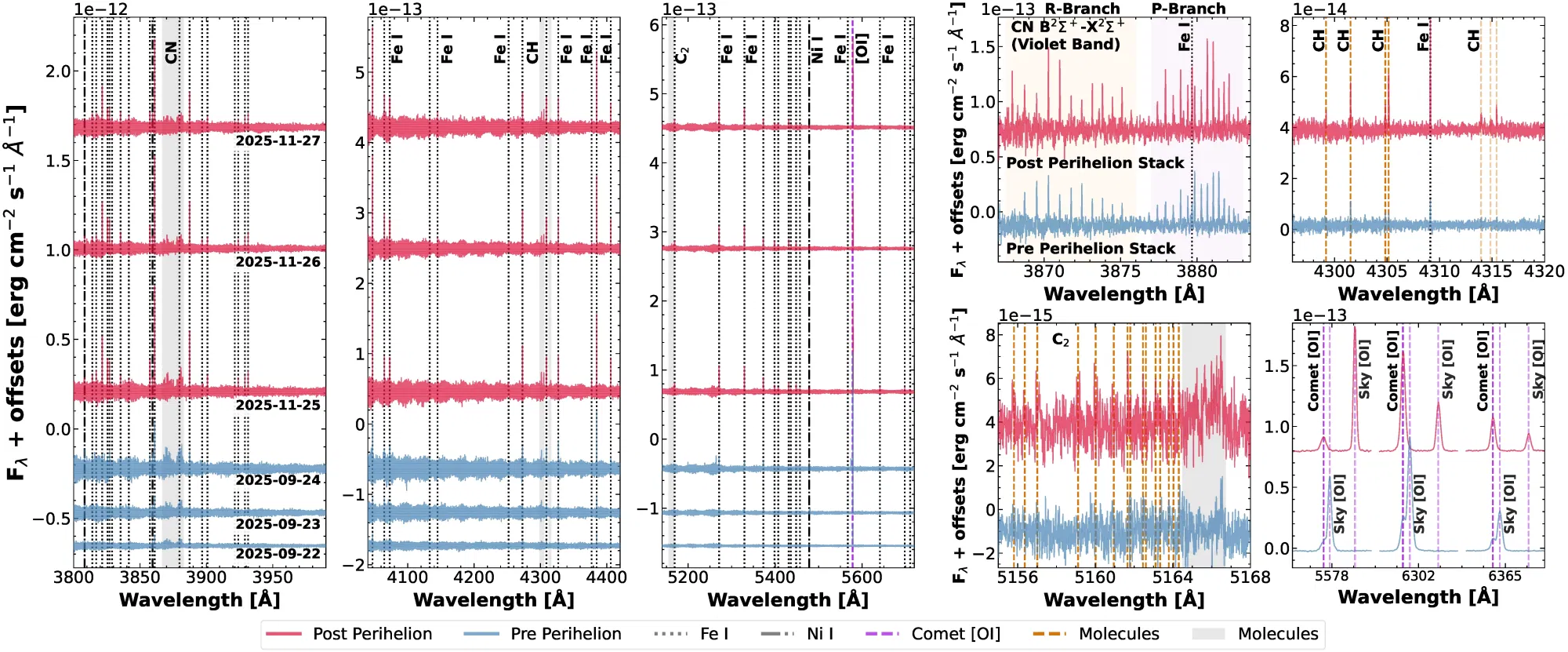
We report VLT spectroscopy of the interstellar comet 3I/ATLAS (C/2025 N1) from rh ≃ 4.4 to 2.85 au using X-shooter (300-550 nm, R ≃ 3000) and UVES (optical, R ≃ 35k-80k). The coma is dust-dominated with a fairly constant red optical continuum slope (~21-22%/1000Å). We report detection of CN emission and also detect numerous Ni I lines while Fe I remains undetected, potentially implying efficiently released gas-phase Ni. We observe a steep heliocentric-distance scaling for the production rates Q(Ni) ∝ rh-8.43±0.79 and for Q(CN) ∝ rh-9.38±1.2...
Interstellar objects (ISOs) provide unique insights into the building blocks and conditions of extrasolar planetary systems. The newly discovered object, 3I/ATLAS (C/2025 N1), represents the third known ISO after 1I/'Oumuamua and 2I/Borisov. We present initial spectroscopic characterizations of 3I using observations from the Goodman High Throughput Spectrograph on the 4.1 m SOAR Telescope in Chile during the night of July 3. The reflectance spectrum of 3I, covering 3700–7000 Å, reveals a red continuum, comparable to extreme trans-Neptunian objects, with a weak UV-optical turnover indicative of complex carbonaceous and irradiated organics...
Hello! I am Jose Baltasar Luco Korn, though I prefer to go by Baltasar. I am a Chilean astronomy graduate student with a deep passion for understanding the universe through stellar populations and its chemical evolution.
I hold two bachelor's degrees one in Astrophysics and another in Mathematics from Pontificia Universidad Católica de Chile, where I developed a strong foundation in both theoretical and observational astronomy. Since 2025, I have been pursuing my Master's degree in Astrophysics at the same institution, deepening my expertise in stellar population synthesis and extragalactic research.
My fascination with astronomy began in childhood. Over the years, this curiosity has evolved into a focused research interest in stellar populations,understanding how the collective properties of stars reveal the formation histories galaxies. I am particularly drawn to using techniques like Surface Brightness Fluctuations (SBF) to probe stellar ages, metallicities, and distances across cosmic time, from resolved to unresolved stellar populations, in simple and composite populations.
Beyond stellar populations, I maintain broad interests across astrophysics, including cosmology, extragalactic astronomy, and the study of interstellar objects. I've had the privilege of contributing to groundbreaking observations of 3I/ATLAS, the third known interstellar visitor to our Solar System, combining spectroscopy with theoretical modeling to understand its composition and origin.
When I'm not working with data, I enjoy exploring new technologies for data visualization, building tools for the astronomy community, and staying curious about the intersection of mathematics, physics, and computation in modern astrophysics.
Besides astronomy research, I have gained diverse experience in science communication, teaching, and even international work. I am passionate about sharing knowledge and connecting with communities through education and outreach.
Pontificia Universidad Católica de Chile
Astrophysics Institute, Pontificia Universidad Católica de Chile • Apr 2022 - Jan 2023
Refined skills in science communication through multimedia editing, social media management, and live streaming. Served as Monitor Coordinator for the public opening of the historic Manuel Foster Observatory (a National Monument), promoting astronomy education and preserving astronomical heritage.
Center of Excellence in Astrophysics and Related Technologies (CATA) • Apr - Dec 2022
Engaged in science communication initiatives, multimedia editing, and social media management. Coordinated and executed diverse educational outreach activities across various schools and provinces within Santiago, promoting scientific literacy and community engagement with astrophysics.
Center of Excellence in Astrophysics and Related Technologies (CATA) • Apr - Dec 2022
Beyond my formal roles, I am still participating in various outreach activities in my free time. The outreach activities I have been involved so far include:
Vail Resorts • Dec 2019 - Mar 2020 • Breckenridge, CO, USA
Worked as a ski instructor under the J1 Visa program, specializing in teaching children aged 3 to 6 years old. Enhanced teamwork skills, fostered social relationships, gained experience working with children, and embodied a strong sense of responsibility in an international setting.
Outside of astronomy:
Photography allows me to capture fleeting moments and see the world through a different lens—both literally and figuratively. I enjoy working with both digital and analog (film) photography, appreciating the immediacy and flexibility of digital alongside the deliberate, tactile process of shooting film.
I take photos of the night sky, everyday life, and landscapes. I enjoy the entire process, from getting the frame shot to editing, finding satisfaction in capturing moments and bringing out their essence through post-processing.
I enjoy making beer from scratch, preparing the ingredients, brewing, bottling, and finally trying the results. I like to test different types of recipes and put my own touch on them, while keeping detailed records to make my brews reproducible.
From all the different beer styles, I'll highlight APA (American Pale Ale) as my favorite.
A selection of moments captured through my lens: landscapes, travels, and everyday beauty.